Monday, October 11, 2010

When Electric Cars & Automated Driving Come Together


In a book I worked on several years ago, we talked about how different innovations can come together to deliver entirely different experiences.  When you combine health care diagnostics and remote monitoring, you don't just get remote monitoring, you get peace of mind for patients.  When you combine two hydrogen atoms with an oxygen, you don't get three atoms of gas, you get wet.

And so it will be when electric cars and self-driving cars come together.  

Electric cars are only just emerging in the market, but they already look different from traditional cars in a number of ways.  To start with, they're a lot simpler.  With fewer moving parts, they're easier to make.  They also use more off-the-shelf parts.  Those changes are already upsetting the established order - letting companies like Tesla into an industry dominated by oversized bureaucracies.  (Link)

Self driving cars are on the way in the near future as well.  The New York Times has a big article about Google's further experiments in this area, And they look promising (link).  Google's cars are driving themselves through the bay area, in traffic, on freeways, and even on side streets with pedestrians, all quite safely.  And what's exceptional today will, thanks to Moore's law, be common place in the not too distant future.

Google's Car, Photo from the  New York Times article linked.
Self driving cars could have a big impact on society - less congestion on the freeways, fewer cars, and greater productivity as people can finally text & drive at the same time.  Oh it's a miracle.

And as the two technologies emerge at the same time, it could completely change society and the automotive industry.  Today, people buy cars and they care about performance.  But if you're not driving the car, why do you care about performance?  If your acceleration and braking are set by the computer, who cares what the 0-60 performance is?

People may stop buying their own cars, choosing to rent them buy the mile.  And once that happens, concerns about the distance that can be covered by electric cars may disappear.  Need to go on a long trip? You can just rent a gasoline car instead.  That could transform rental car companies into the real power brokers, erasing the traditional direct sale of cars to dealers and on to end customers.  Given the reduced complexity of electric cars, they might as well just source them from a big contract manufacturer rather than a traditional OEM.

Self driving cars could reshape our physical landscape as well - leading to a massive new round of urban sprawl and transport consumption.  If you don't have to drive, why worry about how long the commute is?  You can be on the phone the whole way.  If you don't have to take the kids around between soccer and after school activities yourself, why worry about how many trips are involved?

It may all seem quite farfetched today, but the future can arrive quickly and suddenly.  In my experience, it usually arrives long after futurists expect it to and just before incumbents think they are ready for the transition.

Thursday, October 07, 2010

A perfect evening in Bari. Drinks. Hors d'oevres. Dinner.

Monday, October 04, 2010

Blackberry's New PlayBook looks like fun

Everyone's been chasing Apple since the beginning of this year and since then, despite a lot of press releases and announcements, there's been remarkably little action.  Samsung's Galaxy Tablet is a worth challenger, but it's not clear at this time if Android is ready for primetime on the tablet.

Research In Motion's new PlayBook tablet was announced last week.  The announcement was long on promise and short on details.  The technical specifications are promising - substantially better than Apple's iPad in CPU and memory.  The device will also rock Adobe Flash and HTML5 as well as offering a new generation of BlackBerry applications.

I have to admit, I expected BlackBerry's tablet would suck.  Lately, RIM has managed to underwhelm on one new product after another.  The PlayBook, however, looks like it's going to be a good user experience.  Even better, the device can closely connect to the BlackBerry phone, sharing a single internet connection - something Steve Jobs won't allow for the iPad.  That alone could transform the economics of owning a connected tablet.  Add in enterprise-grade security and they could have a winner.

The BlackBerry PlayBook.  No Price Announced Yet.

The newest BlackBerry devices are pale imitations of Apple's iPhone,  with an aging and clunky operating system.  With the PlayBook and the QNX acquisition, it could be well be the start of a new era for RIM and an opportunity to salvage the company's market-leading position.  Lately both LG and Nokia have stumbled in the global market for Smartphones and RIM's share has been eroding as well.

Thursday, September 30, 2010

Just opened up my new Apple 27" Cinema display. Wow! Now that's a monitor.

Cloud To Cloud ETL / Integration: The Next EAI?

Today, my good address book and my Plaxo address book are synced with each other.  But I do it the old fashioned way: through my PC.  Though both services are in the cloud, they come together in the address book on my Mac.    In reality, though, there's no need for that.  Cloud services can and should sync together through the cloud.  Indeed, Plaxo has a beta Google contact sync, but it doesn't work yet (at least not with any reliability).

What's true for consumers today will be true for more and more enterprises in the future:  cloud services will increasingly need to sync  with each other.  And there's no point in routing the data through the enterprise for the sake of clogging your bandwidth or slowing your cycle time.

The need for cloud-to-cloud integration will range from the mundane (sync your salesforece.com contacts with your LotusLive mail application) to the very complex: verifying delivery addresses and inventory availability with your cloud-based ERP and your cloud-based eCommerce, both managed by different vendors.

Today, most cloud users are consumers or enterprise that have one small cloud app hanging off their big fat local ERP.  That's going to change in the future. As more and more companies grow and mature into networks of cloud applications, they will still need ETL and EAI as much as they did before.  But where to it and how to manage it?

Smart cloud apps with implement their own inter-app linkages.  Salesforece.com to and from lots of related applications.  The problem: enterprises no longer have visibility to how that information is being transferred and managed.  That could present challenges in managing enterprise master data.  So, is there an opportunity to create an a kind of cloud-based EAI solution - managing and tracking integration and master data for enterprises between different cloud applications?  I think there's a market for this, getting bigger by the day.


Cloud To Cloud Integration could be powerful.  Photo Flickr CC.

Cool integration of Skype and Facebook is going to make Facebook even more compelling as a platform.

Bookmark: http://ping.fm/6aJan

You can find more of prbrody's bookmarks at
- http://ping.fm/JQ9n3

Tuesday, September 28, 2010

Fraud Never Looked So Good

I've spent the last few weeks reaching out the owners and leaders of online movie web sites.  My goal is to establish business development links to these sites for my new company, Zediva.  The challenge: a depressingly high percentage of these sites are frauds.

They lure people in with the promise of free movies.  And, in fact, it seems like on at least a few of them, you really can find (stolen) first run Hollywood movies.   The reality, though, is that these sites are mostly honeypots - designed to capture usernames, passwords, and credit card numbers.

Technically savvy users know: if you're going to steal a movie - BitTorrent is the place to do it.  Nobody searches the web anymore in hopes of finding a good streamable stolen movie.  At least not the smart ones don't.  For the rest: there is plethora of honey pots online - attracting users with the promise of free movies.  And what's amazing: these sites look good.  It's easy to rip off HTML and the designs for many sites are remarkably simple.  Indeed, I started to recognize the look and feel fo the phoney sites after a while.

So, how do tell if a site is a honeypot?  Well, real web sites have sections like "About Us".  The feature pictures of the entrepreneurs, contact information, and even mission statements.  They have legalese and terms and conditions that you don't see - yet - with the fake sites.  And some of this is hard to fake - at least in a way that's original.

Sadly, I'm sure we can look forward even more realistic fake web sites as consumers wise up to con artists online.

Sites like Cinamuse and Cinemaden (pictured below) look great online, but scam websites contain warnings about them.  I was afraid enough given those notes to not even try to register and find out more.  You can see, however, how professional these sites do look:


Hulu Makes Complicated Seem - Well, Not Terribly Complicated

It's crazy that you can watch some shows on the TV and others not.  Some on the phone.  Others not.  Some expire right away.  Some never.  Some show up a week after broadcast, others the next day.  In the end, no matter how good a job Hulu does of presenting the facts, it's hard for anyone to keep up.  And it's hard to really understand the logic here.

I don't want to knock Hulu too much.  It's not their fault that these terms are in the deals.  And overall, they do a terrific job of delivering video to consumers with limited ads and a high quality user interface.


Monday, September 27, 2010

Continuing Issues with Hulu

Random videos show, other don't.  You can watch The Event in HD, but the latest episode of Chuck is not available in SD.


Sunday, September 26, 2010

A perfect location for breakfast in San Francisco

Friday, September 24, 2010

Is Legal Stuff A Distraction Or A Key Part of Innovation?

There's a tendency to think that innovation is purely about technology.  After more than 15 years in the technology business, I know that isn't true.  Good ideas and great technologies routinely lose out to inferior products.  More enlightened strategies (like IBM's approach to innovation) look at solutions for problems - technology that creates value.

Is the law part of that?  In the past, I would have seen legal issues as impediment to innovation, but not necessarily as a source innovation.  More and more, however, I am seeing that the law itself can not only enable or disable an innovation, it can be a source of innovation.

Ivi.tv, a company in Seattle that is attempting to become a virtual multi-channel distribution system (in other words a cable system with out cable) is engaged in a pitched battle with the major networks and copyright holders over their business model.  IVI is attempting to use the same law that allows cable systems (the ones with actual cables) to retransmit free-to-air broadcast signals.

Is this a loophole or an innovation?  I think it's an innovation.  Having spent the last three months attempting to raise money for my own company, Zediva, I'm tired of hearing about loop-holes.  Property rights and public services are not loopholes, they are essential features of our economy and democracy.  Innovations around how property is handled have been key for our growth.  Joint Stock Companies (public companies with shareholders) were once a legal innovation.  I can just imagine some 17th century VC telling an entrepreneur that selling shares is just a loop-hole for raising money and it won't last.

I've read IVI's complaint in federal court against the major broadcasters.  I have no idea if they will win or lose, but I look forward to the battle. I hope they win - if only because disruption and change bring more innovation.'

A Forest of TV Antennas.  Free to air thanks to taxpayer subsidized spectrum.  Photo CC  D Searls


Amanda Enayati Lives Out My Revenge Fantasy

The other day while riding my bike, a car cut me off and knocking me off my bicycle and leaving me with a nasty case of road rash, a destroyed Rolex, and a damaged $2,500 bicycle.  He didn't even stop to see if I was alright.

As I hear from other cyclists, that kind of thing is a depressing reality.  I admit, I'd like to hunt down the SOB who ran off and knock a few of his (or her, I'm a modern, equal opportunity kind of guy) teeth out.

Amanda Enayati didn't get knocked off her bike, but she did get robbed.  And she found the thief - a lot of very clever sleuthing.  He was out on parole and now he's back in prison. She writes about it in this article on Salon - and it's just awesome.  Check it out.

Shattered Glass, Flickr CC from USB


Thursday, September 23, 2010

What Goes Up Must Come Down?

Is the housing market about to rebound?  I don't think so.  There's some good news: by a number of measures of value, houses are actually fairly priced.  But generally, what goes up too high in financial markets tends to plunge too low.

Exuberance is not the only irrational investor emotion.  I love "The Big Picture" blog (link).  Awesome analysis here and cool chart as well from the site: (Visit the Blog for a nice blow-up version)


Bottom line: house prices in the US are coming back into line broadly with income.  Two problems:

  1. We haven't undershot - which we usually do after a bubble
  2. Incomes are gong up at a snail's pace right now


Got extra hugs from my kids last night. Andrew told me I should try to hold on harder to the bicycle. So cute!

Wednesday, September 22, 2010

Toyota 1, Rolex 0

Toyota 1, Rolex 0. One mangled watch after a car hit me while riding my bike today. Driver didn't even stop! I am ok. Just a few owes.
Toyota 1, Rolex 0. One mangled watch after a car hit me while riding my bike today. Driver didn't even stop! I am ok. Just a few owies.

The Quantified Life: It Gets Boring

I'm a big fan of these quantified web sites.  I wish I had the discipline to keep it up.  But I don't.  I've tried all the different sites and while I think there's a powerful relationship between tracking and performance, I'm not always up to it.

When I am diligently pursuing a goal, I am able to keep up the tracking, but as a day-to-day activity, I find it hard to do.  My attention wanders and it's hard to keep up.  I love the fitbit, for example, but tracking my eating and sleep is just too much effort.  So I'm still able to do the daily exercise tracking (well, the system does it for me) but beyond that…

I'm failing to keep up my data input...

Tuesday, September 21, 2010

Cool Ideas Online: Time for Web Developer Code of Conduct?

I saw this slideshare presentation and I loved it.  There are good sites - like Amazon.com.  They treat their customers with respect and never try to pull a fast one.  There are bad sites, like RyanAir - which require eternal vigilence if you dare use them at all.

I think it's time for a code of conduct, and I like the way this guy thinks:


Monday, September 20, 2010

Problems At Hulu?

Twice this weekend, I tried to watch an episode of Psych.  Impossible - the content simply would not download.  I was able to easily switch to other episodes of other TV shows, but that particular episode of USA's Psych simply would not download.

It wasn't my internet connection and it doesn't seem to be all of Hulu, but it is odd that I couldn't watch just one particular show.

Are TV Stations Helping IVI?

In the last week, ivi.tv has come on the scene and promises a disruptive approach to TV.  Cable television without the cable.  The company re-transmits broadcast signals under the compulsory licensing regime of the US copyright office.  Ivi even allows users outside the US to watch US broadcast TV.

The product is slick.  The quality seems good so far, and I hope it will not degrade over time.  You are limited to live television with basic pause / play functions - pause, rewind, etc., but no true recording yet.  There's a nice selection of the top US networks as well as some minor ones.

Screen Capture from ivi.tv application on the Mac


I immediately subscribed just to try it out.  That said, a few days after subscribing, I don't find myself using it.  The reason: I get my news on the web (not video), I don't watch sports, and I like my entertainment on demand.  Indeed, it reminded me how little I depend on live television in my daily life anymore.  But I am not typical.  For sports fans overseas, this has be a great find and far better value than any of the online services offered to-date.

Reaction has pretty similar across the internet to this new service:

  1. It works pretty nicely.
  2. It's disruptive to existing players
  3. Nobody is sure if it is legal
The most print has been focused on the question of legality.  A great blog entry (link) examines their position and compares it to what is known.  The copyright office seems to have stated quite explicitly that compulsory licensing does not apply to internet services.

I hope that ivi has some novel and important arguments to make the case that it should apply.  I'm no expert in this space, but I do think there should not be a requirement that you string physical cable to a network operator.  As in DSL in Europe, which has had great success, companies should be able to compete with each other on all aspects of the service.

Local TV stations and the broadcast networks should be cheering ivi.  They have long wanted to be paid like any cable network.  If ivi causes the government to re-examine this regime, it could end up being good.  Indeed, at least one blog entry seems to suggest that ivi is capturing broadcast signals at the source with the cooperation of over-the-air broadcasters:

The company has secured the rights to deliver live television feeds from local affiliates in Seattle and New York, with plans to expand to LA, San Francisco and other markets in the near future. Ivi pays the stations an undisclosed amount to pick up the signal, which it does by either placing a physical encoder device at the station or capturing it from satellite or antennae. (Techflash)
Separating content creation, distribution, and physical infrastructure is likely to have a positive effect on competition and consumer value creation, so I hope they achieve some good disruption!
A great reminder that we are really bad at assessing risk. For ourselves and our kids.

Bookmark: http://ping.fm/qr2QL

You can find more of prbrody's bookmarks at
- http://ping.fm/FdOK9

Saturday, September 18, 2010

Nice analysis of IVI's disruptive play. Doesn't look good, though.

Bookmark: http://ping.fm/7yGYE

You can find more of prbrody's bookmarks at
- http://ping.fm/HjJVu

Friday, September 17, 2010

No excuse for more "crapifying" of Android.

Bookmark: http://ping.fm/aX60R

You can find more of prbrody's bookmarks at
- http://ping.fm/d0cbm
Wow, I was skeptical of statements that the iPad was cannibalizing notebook sales, but maybe it really is.

Bookmark: http://ping.fm/ss9I1
prbrody's notes: Wow, I was skeptical of statements that the iPad was cannibalizing notebook sales, but maybe it really is.

You can find more of prbrody's bookmarks at
- http://ping.fm/ebu3S

The Rise of the Righteous DRM Rebel

Now that it's been confirmed that the HDCP master key really has been released (CNET), that leads me to wonder how it got there.  The CNET article today suggests that it was not cracked digitally, but rather leaked.

The Old Way To Copy (Wikimedia Commons)

All this makes me think that DRM today feels a bit like an overstretched imperial regime facing a nimble guerilla insurgency.  The DRM guys have the lawyers, the money, and the government on their side.  For most people, that's enough to deter them from any kind of piracy.  But not everyone.

My colleague, Saul Berman, always said there were two big groups of consumers that the content industry should care about: the cool kids and the massive passives.  The massive passives are paying for content, they want to sit back and enjoy.  The cool kids, by contrast, don't have any money (their kids, after all) but they've got a lot of free time.

With the cool kids, the industry loses some money, but not a whole lot.  For high income adults, the time required to infringe on copyright and risk to their financial assets isn't worth it.  For kids, however, even if they copy, it's not likely they would have bought if they could have in every case.

But we have a new and growing group in this game: I'll came them the righteous rebels.  They don't like DRM because it's evil.  They're not in this for the free movies.  They're in this because it's morally wrong and economically destructive.  And both government and industry keep fueling the fire:


  • The DMCA restricts free speech for security researchers (Wikipedia)
  • Russian government uses copyright licensing to silence dissidents (New York Times)
  • ACTA treaty restricts freedom of expression and privacy (Wikipedia)
There have always been people who said that knowledge just wants to be free.  I can't agree with them: intellectual creations must be encouraged with proper protection.  Without some restraint, however, we could bring the whole regime down.

Thursday, September 16, 2010

Chaos In TV Industry Reaching Peak

It looks to me like the chaos in the TV industry is headed towards it's peak level in the next few years.  For a long time, there have been indications that the wrenching transformation of the music businesses is going to be visited upon the video content and device business.

Battle for TV Goes On (Picture from Flickr user Ed Brambley)

At times, it has seemed like the video content and device companies have taken bold steps to avoid that fate, and with some success.  The rampant piracy of the Napster era seems to have been pulled back and there are an increasingly good set of online services for video watching for consumers.  Still, this may not be enough to stop wrenching change.

So, if there's more and more good content available online, why is there still so much pressure driving change?  I think there are four reasons:

1. Devices:

The devices people use are in transition, and that transition is far from complete.   Traditional TV set-ups are based on over-the-air and cable transmission of channels which are live all the time and use of physical media.  In the new era, most content will be delivered on-demand over IP.  

A wave of new boxes - from cable providers to consumer electronics companies - at aggressively low prices is going to sweep the industry in the next 18-24 months.  At $99 or less, these boxes are within reach for almost any consumer.  Google TV won't debut there but it should get there quite quickly.

While these new set top boxes are surging into the market, the big hope of the CE companies - 3D - is fizzling.  New data shows that people who have seen 3D TV are actually less likely to want it.  Bad news for the big TV makers.  (Link)

2. Content

The availabilty of content online is getting better, but overall, it's not very good.  It's costly, inconvenient and limited.  If you are a top-tier cable subscriber, your access to content online is increasingly good, thanks to services like TVAnywhere.  If, however, you're a cheapskate or you live outside the US, your options are few.

Even within the US, it can be maddeningly frustrating to try to watch TV on anything but your TV.  I have Hulu+, and while I pay $10/month for this service, I can get only about ⅓ of the shows in my queue on my iPhone.  I do not believe that consumers will be satisfied with 

3. Distribution

The TV channel is becoming a waste of bandwidth.  The idea that you should get hundreds of channels simultaneously piped into your home is pointless, chances are most of them are showing re-runs most of the time.

As TV shifts to on-demand and IP-based, there's no need to have channels, per-se, anymore for most content.  And as all content shifts to IP-based, any provider can deliver that content.  Globally, this is good news: most people will now have a choice of content distribution companies - be they cable, DSL, or wireless: it's all the same: delivery of IP to the end user.

That is not to say that there isn't demand for live continuous streams.  People still watch live events like sports and news, and many people still enjoy plopping in front of the couch and watching whatever is on.  Not because it's great, but because it's relaxing not to select anything, just to watch.  Even so, that need can be accommodated more efficiently over IP than by giving you 500 continuous live channels.

4. Advertising

Hulu in the US has shown it to be true beyond a doubt: targeted ads are much more valuable than mass market advertising.  Advertisers are still trying to convince themselves that big budget superbowl ads have a place.  And maybe they do, but most advertising is more productive when it is targeted online to individual users.


All these transformations are in progress, and the final shape of TV in the future will not really be seen until they start to converge in a single device and service - with a clear integration of content, payments, and advertising.  iTunes played that role for music: device, user experience, service, content and payments all came together in a single solution.  Such a vision still does not exist for television.

And in the background to all this transformation: one more thing: piracy.  After a decade of lawsuits music piracy is alive and well.  Thanks to reasonably priced legal alternatives, there are many people in the developed markets who have passed on such behavior.  But it's still there, on college campuses and in emerging markets.  And video is actually now consuming more bandwidth than audio.  

News that the Blu-Ray disc keys have been permanently broken (link) is a timely reminder that no solution is very secure.  It's hard to think about free as competition, when free is illegal.  But it's real - and without the creation of value-for-money alternatives to illegal copying - it will get larger and not smaller.


Tuesday, September 14, 2010

Wireless Carrier Meddling Will Keep Apple Ahead In Wireless

Over at Engadget, Michael Gartenberg has a great article on how wireless carriers are crapifying Android.  Replacing Google search with Bing, removing free navigation, etc.  (Link).  That's the problem with open source: anyone can screw it up.

From Engadget: An Android Phone with Bing search...weird, huh?


With Android, while the product gains share, innovations trickle out in haphazard manner, unlinked to carriers or hardware innovations.  Apple, on the other hand, is able to launch coordinated surges of innovation - linking hardware, software, and services together.  The result: big leaps, not a steady drip.

For the moment, this will keep Apple ahead, and it could be a sustainable advantage for some time.  Beyond that, as Gartenberg points out, the carriers will need to decide if they are going to keep things clean and consumer friendly or keep crapifying the product.

I will add one prediction to Gartenberg's article: I think we'll see a vibrant market for unlocked Android devices in prepaid - something that could have a big competitive impact on the market.


Monday, September 13, 2010

Cracks In The Metered Wireless Broadband Plan

Every smart telecom analyst will tell you that the days of unlimited wireless broadband are coming to an end.  I must be stupid because I'm can't agree with that.  In fact, I think the players who are pushing hardest on this in the US may be the most out-of-step: AT&T and Verizon.

Consumers don't understand what a megabyte is.  Even in the industry, as a savvy user, many people don't really know what drives their consumption up or down.  Yes, movies and music do it, but a single web page can range from 100kb to 1mb, depending on what's on it.  Consumers don't understand electricity either, however.  That doesn't mean it's not metered.

The real constraints on metered wireless broadband are technology and competition.  Technology is dropping the cost of transmitting data by more than 50% with each subsequent generation.  Wireless carriers are also making their networks denser and improving back-haul, which is adding capacity for wireless data.  This means that even as carriers try to impose constraints, the cost of delivering that data is dropping significantly.

Interestingly, the cost of a mobile broadband monthly card - around $60 from the major carriers - hasn't changed in years despite the transition from 2G to 3G and now the approach of 4G.  Business users have proven remarkably price insensitive as demand has surged.

The other constraint is competition.  You can't change your electric company, but you can change your wireless carrier very easily.  And the rise of prepaid wireless and the plunging cost of electronics is making easier for consumers to switch around.  Virgin in the US just started offering a prepaid MiFi for $150, no contract, and monthly unlimited usage of $40 - no strings or constraints.  And while Verizon caps data card usage at 5GB, their new smartphone plans have no such cap, unlike AT&T.

$60 A Month - 5GB Cap
$40 A Month - No Cap

Thursday, September 09, 2010

Android TVs Will Triumph In The Market

Every TV at IFA had some kind of widget or something built in.  Most of them are proprietary widgets - companies like Netflix paying generously to make sure they get featured on these devices.  But these proprietary widgets have limited value because they operate in relatively closed TV company ecosystems.

Most of the "Apps" that thrive in the TV ecosystems are just wrappers for other web services.  They package H.264 video or HTML data in ways that work nicely in the TV environment.  The cost of developing these simple wrappers is not too high: say $30-50k of developer time for most companies.  The problem is the enormous proliferation of these services, each with different terms & conditions.

We all know, or we all think we know, that somehow, someway, over-the-top content and services will take hold in the television environment.  We just don't know which ones.  It's a bit like the iPhone.  It's easy to forget that when the iPhone launched, there wasn't really a provision for Apps.  Apps came later, and they came only after intense demand from users.  And even when Apple offered up the App store, nobody was sure in advance what kinds of apps would thrive.

We do not know what the magic set of applications is yet for TVs.  Will people want games even if they're not console quality?  Will they want music or video or will they keep getting that from their cable companies while seeking out something else online?  With so many choices emerging in online video, I think search alone is a big opportunity.

With so many platforms out there, even $30k per platform quickly becomes prohibitive for all but the largest companies to spend on a speculative venture.  Enter Google TV.  You can write an app for Google TV and it will work across multiple companies systems.  Better yet, it will also work on Google tablets and Android smartphones.  And the open nature of the Google environment means no arbitrary rejections either.

As a result, in a matter of months, I believe we will see more apps for Google TVs than there are for every other TV platform out there.  Combined.  The massive momentum of the Google developer community will power this platform forward even as the cost of chipsets keeps coming down.  Many manufacturers have passed on Google TV because it costs a lot in CPU power (Flash and all!) but that may turn out to have been a false economy.

Sony's New Google Powered Internet TV: A Smart Move

Wednesday, September 08, 2010

MiFi Update: T-Mobile Makes It Work

Round two with the MiFi.  I spent half an hour at the T-Mobile store in Berlin this morning.  Now we're cooking with gas.  Correct SIM card is loaded and funded, service is activated, and has been working flawlessly for three days.

As for the MiFi itself, you realize quickly as you're walking through the IFA trade fair that four hours of battery life is far from enough.  It's a pain to keep digging into your briefcase to switch the device on or off.  Alternatively, I can attach my HypermacMicro to the device in my bag, in which I get a solid 8-12 hours out of the device, but that's an act of desperation....there's no battery left for my iPhone should it need recharging.

Overall, T-Mobile's service is great and and the price is right - just 5 Euros a day for unlimited mobile broadband.  At 150 Euros for the month, a bit overpriced, but for a business traveler comparing that to the high prices or poor service of hotel internet, a bargain.

The Front Entrance at IFA: The Beginning of a Very Long Walk

Tuesday, September 07, 2010

If you find yourself with some free time...

Spend a day or two reviewing the terms & conditions updated for iTunes.  They're only 55 pages.


My Favorite iPhone 4 Applications

Well, I have had my iPhone 4 for about 2 months now and so I've decided that it's time to put together a list of my favorite iPhone 4 apps to share around.


#1: Google Maps

It works better on the iPhone than anywhere else.  The combination of a good data link, fast GPS location lock and the best search capability around makes it excellent overall.  I wish it had biking directions, but overall, the single most used app on my iPhone.

#2: Safari

The best mobile browser I've ever used - good enough to check out just about every important web site.  The screen may still be small, but it's still very usable and fast.  From checking in to your flight to checking your bank statement, many services still work best online through a browser.

#3: Documents To Go

I wouldn’t recommend editing lots of documents but it's great at viewing.  I have a smart folder on my mac and I use it to find every document I've opened or modified in the last 90 days.  That means lots of PDF files, lots of excel and PPT, etc.  I dump them into my iPhone and then I can access them anytime I want or need them.  It can also go into Google docs and retrieve other documents.  Viewing capabilities are excellent, even in Powerpoint.

#4: Evernote

I use Evernote as my online filing center for notes, check-lists, and meeting information.  If I don't know where to put something, it goes in Evernote.  And having the locally synced version on my iPhone is just amazing.  Search is fast and useful as well.
#5: JotNot Pro

I travel a lot and I don't like paper.  JotNot lets me "scan" all kinds of random information - such as receipts or other documents - and then file them in Evernote or somewhere else.

#6: Instapaper Pro

The best way to read news articles comfortably.  Instapaper Pro let's me copy down key articles I want to read when I'm offline or just am too busy to read them now.

#7: Kindle

I don't read a lot of books on my iPhone, but I do on my Kindle and my iPad.  Having them all here means that anytime anywhere, I can just pick up the story where I left off.

#8: Pandora

Music to go.  The best music to go.  Anytime, anywhere.  I know my data plan is capped, but music isn't going to blow it out.

#9: Hulu Plus

Now this will blow out your data plan, but when you want a fix of TV, it's the best way to get it.  Hulu Plus is still missing lots of good content but there's always something to watch and it can be a great way to unwind in a boarding gate or while you're waiting for other stuff.

#10: GPS Drive from MotionX

A great value in voice directions with good results to-date.  The service seems to perform very very well without taxing the CPU too heavily.  Overall, a pleasure to use.


I buy a lot of apps.  I'm a sucker for just about every online service you can imagine.  But after two months, these are the ones that have stood the test of time and I hope will keep going in that space.   Later on, I hope I can write up a list of the iPhone apps I'd like to see.


Monday, September 06, 2010

Using Your MiFi with Prepaid: No Easy Task

I bought a new MiFi for use in Europe with prepaid mobile broadband.  Unfortunately this is no easy task as I'm discovering after burning through 40 Euros in 12 hours here in Berlin.

MiFi is a great solution for mobile broadband.  The device is small and compact and works nicely.  Nothing to complain about there.  But getting online in Europe (or just about anywhere else) is difficult and tedious.

Yesterday was a good example.  I wandered around Frankfurt airport looking for a place to buy a prepaid SIM card for mobile data.  I found an o2 store.  When I asked for the SIM card for mobile broadband, at first they did not understand what I wanted.  After some back and forth, they got it.  The o2 package is 15 Euros for the SIM card and another 25 Euros for 5GB of data in a month.

Apparently, the way it's supposed to work is that the package is requested by SMS message and then once activated (about 30 minutes later) you can surf.  Problem: MiFi devices from Novatel don't offer SMS.  So no way to request the package.

The store employee used his phone to request the package, but since I could not see the SMS message in question or the reply, I can't know what happened.  All I know is that one morning later, my account is empty and I get a top-up message instead of Google.com when I log in.

I'm going to try today to switch to T-Mobile and see if that's a better experience.  In the UK, you can do everything from a web interface, no SMS required.  Hopefully, it's the same in Germany.  Of course, in a foreign language, everything is much more confusing.  And your average mobile store employee still has no idea what an APN is, nevermind the username and password.

It may be a tiny fraction of the cost of roaming, but man it's a lot of work getting mobile prepaid broadband to work.

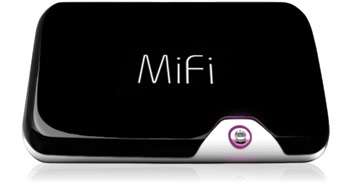
MiFi Image, From http://www.flickr.com/photos/abulhussain/

Sunday, September 05, 2010

Hands On With Samsung's New Galaxy Tab

I've got just about everything Apple makes these days, except that tedious little hobby device the Apple TV.  Other than that, I've got it all.  MacBook, iPad, iPhone, and iPod.  But I have noticed the rise of the little thing called Android.  It's getting hard to ignore and Samsung is now pushing Android into the tablet space in a way that should be taken seriously.

There are a lot of aspiring competitors to the iPad out there.  Few of them should be taken seriously, but this is one of them.  Android is a close second the iOS when it comes to usability and power, but far more open and flexible.   And that growing strength is put to good use in the Samsung tablet.


Yesterday at IFA, I spent some time playing with the new tablet, all the while comparing it to the iPhone I had in my pocket and the iPad I had in my briefcase.

The device looks and feels very nice.  It lacks the drop-dead beauty of Apple's devices - the milled aluminum and glass - but it also seems much more likely to withstand a drop from a height.  I guess, in the crowded atmosphere of IFA, I could have dropped the demo unit and seen if it broke, but that didn't seem like a good thing to do.  I am not willing to test the durability of my Apple devices, given their replacement cost.

As for size and weight, it's pretty nice.  The iPad is magnificently light for a PC but it is tiringly heavy compared to my Kindle for reading.  When I do any extended reading these days, I find myself propping it up in a way that doesn't require being held.  The Galaxy Tab feels light enough to hold for hours.  The tablet is 380 grams, according to Samsung, 100 grams more than a Kindle and about 300 grams less than an iPad.

Like the iPad 3G, the Galaxy Tab comes with a full wireless modem, but you can also make phone calls.  I don't see myself wanting to in general, but it's possible.  Also, because it has both a front and rear camera, you can do video conferencing, but I could not figure out if that was carrier supported or enabled and supported by Skype in Android.

The device has Flash 10.1 running, so I was able to test a couple of video sites.  The result: great smooth video and no indication that the CPU was straining to work properly.  I've heard people complain about the implementation of Flash on mobile devices, but this sure seemed to work fine.

While Samsung can never be, and probably shouldn't aspire to be, just like Apple, the company keeps turning out well executed products. Indeed, of all the gadgets and gizmos I saw at IFA this year far, this is the only one I'd be willing to spend my own money on.


Vinyl. Still not dead.

From IFA.  Vinyl and Members Only jackets.  Two things I do not have.


Friday, September 03, 2010

IFA: What's Hot This Year?

The amazing thing about the electronics industry is it's ability to turn anything from a profitable niche into a painfully cheap commodity.  In recent years, as companies have retreated away from feature-function overload, they have moved towards design, style, and health / wellness issues.  The result: everyone is selling a sleek black TV set and a blender that makes smoothies.

Last year at IFA, we got a dose of a bunch of soon-to-be-failing fads at IFA:

  • 3D TV: I never thought this would take flight, and it really hasn't.
  • Skype-On-TV: I thought this would hit, and it hasn't
In general, despite all the efforts to converge, TVs are still TVs.  But like all tectonic shifts, the rate of change accelerates over time and by the time it is visible in the mainstream, it is nearly over.  And so it will be internet TV, which is truly gathering momentum.

New fads this year at IFA?  3D TV is still on the menu and mobile video is rising up fast.  Internet connected appliances are also starting to arrive.  But will they make us all smoothies to sooth our aching eyes from 3D TV overload?

Smoothie Image, Flickr CC Maltman23

Thursday, September 02, 2010

Philips is Going To Do What Apple Should Have

Philips is bringing out a new GoGear.  Don't get your hopes up, Philips does not have a track record of mobile media blockbusters, but they are doing something quite cool: making a kind of Android version of the iPod touch.

The iPod touch has long be a lot like the iPhone, but without the phone.  Apple has always crippled the iPod touch - leaving out key features that would make it unusable as a everything but GSM iPhone.  Partly because this might damped demand for the iPhone itself, but mostly because it might also reveal just how much margin is in the iPhone.

Philips has no such attachment and they can put most of the Android phone content into such a device.  I'm interested in seeing where it goes.  Handheld computing is now truly everywhere, but the cost of yet another GSM subscription is more than most people want to see.  The New Philips GoGear has most of the stuff in an Android phone, except the phone.

One key challenge Philips will face: Android is much weaker than Apple when it comes to handling media so it make take several iterations to make this work as a viable alternative, but as Android gains ground more and more people will want a subscription-free version of the device.


Engadget update.

Photo from Philips


Wednesday, September 01, 2010

Small Revenues, Big Fees: PayPal Scores In Online Media

$0.99 for a TV show?  $3.99 for a movie?  Good deals for consumers and Apple has set a very generous standard of giving 70% of film and music revenues to the copyright holders.  The challenge for competitors: that leaves just 30% of the total live off and that's not a lot if you want to take credit cards from consumers as payment.

PayPal and Google Checkout are two of the biggest companies in the market space and they both ask for similar fee structures: $0.30 plus a portion of the purchase value - between 1-4% depending on your monthly revenue run rate.

So, on  $1 product where 70% goes to the supplier and $0.30 goes to the transaction processing company that leaves precisely $0.00 left to live on.  Makes it hard to grow any substantial volume in those conditions - perhaps by accident or design, that has left the market with fewer competitors.

The major credit card companies do not charge $0.30, but linking to them directly brings it's own complexity and cost and they are not exactly free either.  In the end, small payments online face some big challenges: how to keep the cost manageable.

Big companies have scale: they can interlink directly to the banks.  They also have volume.  It's true, Apple gives 70% to copyright holders for content, but they can also batch charges to your card if you buy more than one item and they also do things like offer gift cards.  All of these have their own costs too (as well as dis-economies of scale in large enterprises).

That makes advertising look like a very attractive alternative to micropayments.  Rates online have been rising fast in recent years - Hulu leading the way - but they are still not enough to cover the cost of most top-shelf content.

What then? Well, I'm not sure yet.  I'll let you know when I figure it out.


Tuesday, August 31, 2010

Electric Bicycle Tales

After a lot of careful condsideration, I finally did it.  I broke down and bought a new Trek Valencia+.  That is the middle-of-the-range Trek bicycle.  All three Trek bikes are about the same price, but the Valenica is the most commuter friendly of the three.  The 7200+ is heaviest of the bikes and that's why I didn't get it.

Three weeks into the ownership of the bike, in some ways, I find that I no longer need the battery all that much.  When I first bought the bike, I needed the battery to get more than 15 miles.  Yesterday, I clocked up about 80 miles, of which only 15 were supported by the battery - the last 15.  I didn't intend to go 80 miles, but thanks to a Caltrain breakdown, I found myself biking back from San Francisco as well as to it.

As my level of fitness has increased, I found myself wondering: do I really need the batter at all.  The answer is yes.  I need it for two things:

1. Confidence: With a battery on the bicycle, I can go further without worrying if I will feel like making it back or not.  In the past, just the prospect of being too tired might have deterred me.  Now, I go anyway.  And most of the time, I push through and pedal back without using the battery.

2. Arriving Composed.  Yes, even if you know you can make it, that doesn't make it you will make it without being a sweaty mess.  Now, I can go to meetings and, using the battery, and arrive in pretty good form, having gotten some fresh air along the way.

I'm still finding my way around the better routes, but in Silicon Valley, there aren't many meetings that are more than 15-20 miles from Woodside.

Flickr Image, CC, from G Whalin.

Monday, August 30, 2010

The iPhone on AT&T: Just Terrific

We are so good at complaining about AT&T and the iPhone, but I have to say, after two months using the iPhone 4 on AT&T's network: it's great.  It's not just great: it's better than just about every other combination out there.

I'm a mobile phone whore.  I've had em all.  On every carrier.  In the last five years, I've had Sprint, AT&T, T-Mobile and Verizon.  I've two iPhones and at least five Blackberries not to mention a couple of Nokia phones.  Everything but an Android phone.  And the best of them all: iPhone on AT&T.

There are a few things that make the combination the best of the best.  The iPhone itself is great as a stand-alone device, but the newest iteration excels when you add multi-tasking and a strong network.  I put the iPhone on AT&T to the test and in functions where Blackberries and other networks fail:

  • Continuous Music Streaming: On AT&T, Pandora runs smoothly over long trips - not missing a beat.  By contrast, neither Verizon & T-Mobile were able to accomplish the same feat on longer trips.  T-Mobile has the best value of all the networks - but it signal frequently drops down from 3G to edge, making it hard to keep up a music stream.
  • Music Streaming & Navigation: The iPhone on AT&T seems to handle multiple processor-intensive applications smoothly.  The combination of CPU-intensive and bandwidth intensive often sent my Blackberry on Verizon into a reboot but the iPhone seems to handle it smoothly.
  • GPS Fix: the iPhone latches onto a GPS signal with amazing speed - faster than any Blackberry ever.
I've seen the new Blackberry Torch.  It's a nice looking phone and the best Blackberry ever.  It won't be enough to turn the tide.  RIM's going to have to up their game again.

iPhone Photo from Flickr, CC

Sunday, August 15, 2010

When The Punishment No Longer Fits The Crime

As human beings we are deeply flawed.  I don't know anyone who doesn't do bad things.  Some of the bad things we do are illegal.  Some of them are just mean.  And as human beings for all the bad things we do, we are also able to tremendous good. 

One of the greatest things we can do is to forgive ourselves and each other for failures in judgement and move on with life.  The New York Times has written eloquently about how in the online era, since we cannot erase our pasts, we may have to learn how to forgive failures and lapses that might have just disappeared in the haze of time and distance in the past.  Now they live on forever in Facebook or the Google index.

For all the smart thinking about how we need to get better at forgetting and forgiving, as a society it seems like we're getting worse at it.  Zero tolerance policies and three strikes laws are driving schools, businesses, and law enforcement towards pushing punishment out of all proportion with the crime.

And what do we gain?  Arbitrary enforcement and terrible destruction of lives when these policies are applied.  Behind these extreme policies are some very flawed ideas about fairness and justice.  One of the worst is the idea that by applying a zero tolerance policy you are being fair.  Enron did not fail because a middle manager booked used a blank receipt to cash in an extra taxi ride - the company failed because of fundamental fraud at the very highest levels.

Another fallacy behind our trend towards "extreme" justice is the idea that failings in one aspect of a person's life necessarily point to similar behavior in others.  Not so.  People are not uniform or consistent.  There's many a brilliant scientist who can master complex chemical formulas but can't remember what kind of oil to put in the car.  So it goes in life.  Exceeding the speed limit is not "gateway crime" to murder.

In schools, law, and business, it's time to restore a sense of proportion to our approach to justice.  Mark Hurd should get his job back.  Stpehen Slater should be back in the air.  And we should all just learn to go easier on each other.

Less Jail Time, More "Teachable Moments" - Prison (Photo from Flickr, CC)


Friday, August 13, 2010

What Google TV Needs To Do - Integrate Integrate Integrate

The market for online content is coalescing quickly.  The past few days Netflix has announced a stream of big deals designed to bring fresher content to their online offering.  The deals look expensive, given their high customer acquisition cost and churn rate, but they may not have much choice.  Postal costs are rising and users are increasingly looking online for content.

At the same time, Hulu Plus is getting rolled out.  With Hulu Plus, you can watch full seasons and enjoy many programs in high definition and on mobile devices.  Combine that with free over-the-air television for news and major sports, and you have the makings of credible alternative to cable television for lighter TV watchers.

Hulu Plus is $9.99 monthly and Netflix's streaming plan is $9.  That means $18.99 for the two combined - a pretty reasonable price for so much content.  But what's missing is the integration.  One user interface, one program guide, one way to find what you want and then watch it.  Hence the opportunity for Google TV.  Integrated and simplified, it could prove that even on TV, search is the killer app.

Hulu Plus + Netflix: All Your Entertainment Anywhere You Go  (Photo by Daily Life of Mojo)


Thursday, August 12, 2010

Financial Industry Still Defying Gravity

The Economist has a great article last week about how fund managers are measured.  It points out that both in private equity and most mutual funds, fund managers often take home millions or billions in pay for performance that is mediocre or nonexistent.  I learned this back in college as an Economics student that stocks are largely a random walk and that index funds are the most efficient way to invest.

So far, nobody has been able to refute that basic idea around investment strategy, but neither does it seem to have gripped most investors. The academic research shows over and over again that investment advisors are a waste of money.  And the press shows over and over again that those same people keep getting paid more and more money.  (Economist)

How long can the whole industry defy gravity?  The more I see things like this, the more I am concerned that Wall Street has gotten too big for America's benefit and that it is no longer functioning as an efficient distributor of capital.  And really, it's a shame I learned all this useless stuff in college.  If I had majored in English and gone to work at Morgan Stanley, I'd be rich by now.

Wall Street - Still Larger Than Life (Picture by HMerinomx)

Tuesday, August 10, 2010

No Cellular Data, No Problem

Without cellular data, it would seem impossible to get your e-mail on your mobile phone when traveling overseas.  Not so.  I have an unlimited text messaging plan and receiving is free.  So all my e-mails are being forwarded to me by Google as text messages.

Elegant?  No.  The formatting is terrible and the iPhone handles text messages poorly, but it is free and it does work.  Since 90% of the time I am reviewing and reading messages to check content, this is very effective and costs me nothing.

If only I could get a feature in G-mail labs that would strip all unnecessary formatting and send a clean, crisp text to my phone - then it would be almost perfect.  There's no real replying either, but for the moment, this is far cheaper way to get my current notes overseas than actually using AT&T's data roaming.

Text Me.  Image by Erik Schlange

Monday, August 09, 2010

My iPhone 4, Un-Jailbroken

When it comes to technology, I try most things once, sometimes twice just in case I thought it did it wrong.  That's what happened to me with my iPhone 4.  I jailbroke it and unlocked it twice yesterday.  After two tries, I unjailbroke it and restored it to AT&T's total control.

The iPhone 4 is the best mobile phone I've ever owned, but it has two problems:

1. It's carrier locked
2. It's a bandwidth hog with few fine-grained controls

The result is a painful lack of functionality when traveling overseas.  I've checked - looking at data consumption info - and seen that checking e-mail even once can consume as uch as 4 megabytes of data.  That's about $4 if you have a data roaming package and you're retreiving images with your messages.  Far too much money to be sustainable.

The result: the phone becomes a $300 iPod Touch when outside the US.  If you could jailbreak it, then you could put in a local sim card and use your phone like a native, provided you can figure out how local data services are configured (not always easy).

Jailbreaking is ridiculously easy and unlocking is too, using the ultrasn0w system, but unlocked phones appear to suck battery for some reason - 3-5% of battery per hour when unlocked in standby mode.  The user forums are full of notes about this and so until that issue is solved, it's rather infeasible to have the phone unlocked.  Hence my re-locking.

I think this issue will be solved soon, I suspect, and when that happens, I will probably re-unlock my phone whenever I travel overseas.  I'm keeping my contract and services with AT&T, but the cost of global roaming is too much to use the phone outside the US without it being unlocked.

iPhone 4, still locked.  Photo from SuperStriker2

Friday, August 06, 2010

Amazon Should Keep On With The Kindle Hardware

Doing hardware right is difficult.  You need to be cheap and continuously cutting costs, but you also need to be high quality.  And these days, consumer electronics hardware needs to be beautifully integrated with software and services.  Amazon does these things remarkably well.

Indeed, the most powerful feeling I had when opening up and using a Kindle for the first time was what a fantastically Apple-like experience the whole thing was.  High quality. Attention to detail.  Excellent services.  Nice packaging.  Amazon.com does hardware right.

And they should keep doing it.  While Kindle is now more a utility than a piece of hardware (it's everywhere, on your iphone, iPad, Android device), there may long be a market for dedicated eReaders.  They are easier to use than tablets and the eInk screens feature excellent contrast.  As eInk prices keep dropping, it may also be possible to offer eReaders with very very low prices.

If anyone can continue to make this experience worthwhile, it's Amazon.  I'm not sure Amazon could succeed in bringing us an Android tablet focused on eReading, but I am confident that continued offerings in the dedicated eReader space could be a huge success for them.

Still The Best eReader.  Photo by Windell Oskay

Thursday, August 05, 2010

Slow Going on GoGo

GoGo inflight internet is invading the US skies.  About 2,000 planes, I'm told, have in-flight internet service in the US.  Yet my experience with GoGo is remarkably mediocre.  Bandwidth feels mostly like dial-up, especially when sending content.

Streaming media is definitely not feasible, but it's just fast enough to do instant messaging and replicate your e-mail.  For most business users, that is enough to make us productive, but not enough to really make the experience enjoyable.

On top of weak bandwidth, the service itself seems to be somewhat random.  The web page for logging in and payments works poorly and just getting online often requires intervention from customer service.  For long flights (transcons) it feels essential, but for shorter ones, I think I will not bother in the future.

Staying Connected On The Road (SFO Photo by Ack Ook)

Federal judge affirms the blindingly obvious. Next up: federal courts to confirm sun still rises every morning.

Wednesday, August 04, 2010

Are Global Data Roaming Prices An Example of Market Failure?

I passed a sign in the airport at Heathrow yesterday.  Vodafone was advertising global data roaming packages from $1.60 per MB.  Roughly translated, that means my AT&T package in the US of 2.5 GB is about $4.000 when consumed by roaming - this is 160 times the local price.  Voice minutes are, by contrast, about 10 times US prices when roaming - assuming an averge per-minute price of $0.10 and a roaming charge of $1 per minute.  That, by the way, is the "special" package.  If you don't buy a package in advance, you can be looking at even higher rates.

Is this an example of a market failure?  I think so.   While there is competition between mobile operators, it's primarily focused on domestic markets.  Including roaming services in the packages is not a key part of the decision-making process and once you are locked into a contract, just giving up your mobile is not really an option.

There are more and more options for savvy travelers, and increasingly it is less sophisticated users who find themselves gouged when they return home to a $2,000 roaming bill.  In Europe, regulatory intervention in the market for voice roaming has done much to bring down fees and benefit consumers without any evidence that it has hurt companies.

The same may be true in data roaming.  There is no compelling business reason for charges 100 times higher in roaming and it is clearly in the public interest to reduce those charges and make data services more accessible to travelers.


Get Ready To Pay.  Picture from James Cridland


Tuesday, August 03, 2010

Why The Churn?

Everyone I know loves NetFlix, but as I dig into their financials to understand more, I'm seeing that average churn is about 63% annually.  That means that for every 100 people who subscribe to Netflix, about 63 of them quick annually. 

That's a lot of turn-over.  Yet when you ask people if they like Netflix, the answer is always yes.  The company's standard of service is very high and their investment in online services is leading the industry and bringing along many consumers.

So why the high rate of churn?  Could it be that the content is itself simply not compelling?  Or could it be something else?  HBO's churn is about the same level - and again, while people say they love HBO - the majority of those customers are likely to drop the channel within one year of subscribing.

So what gives?  People don't drop cable. They don't drop satellite, but they do seem to drop premium and movies from their list quite frequently.   The question is why, since the movie business is quite robust and many subscribers seem to return to these services over and over again, only to leave them later on.

Netflix Envelope from Flickr User Rieh

Monday, August 02, 2010

Are You On the TSA Diet?

I am.  I don't consider myself overweight, but I've never been the type of rip off my shirt and flaunt my six pack on the beach. This is probably because I don't have a six pack.  Or big arms.  I've also got some small love handles.  In the past, none of this has really mattered that much.  I live in the bay area where it's cold most of the year and I work in a office that often requires a suit, or at least clothing.  Generally, I look fine in clothes.

The global deployment of body scanners poses changes everything.  Now, twice a week, I will be required to strip naked (electronically) for the viewing pleasure of the TSA staff.  Because I have no trust in my government's promises to do nothing with those pictures, I fear the consequences.  Those love handles will he electronically stored and distributed using the full power of the internet.

And so, I'm now starting the TSA diet.  The TSA diet is for all business travelers who used to think that it was just ok to look good in a suit.  We used to think of a six pack as a convenient way to carry beer, now we must we tune in to episodes of the Jersey Shore to catch up on what's what.

The foundation of the TSA diet is the elimination of airport food.  This is worst kind of food known to humanity.  Every Cinnabon you eat adds measurably to your waist line.  Also banned: those delicious warmed nuts they serve in first class.  Also, I recommend taking all your conference calls while walking up and down the concourse.  This is much healthier than finding a seat near the buffet in the Red Carpet Club. 

The airlines have long feared the security procedures will deter people from traveling.  This may now be true.  We can all handle delays and horrible service, but public humiliation?  Not for me, thank you.

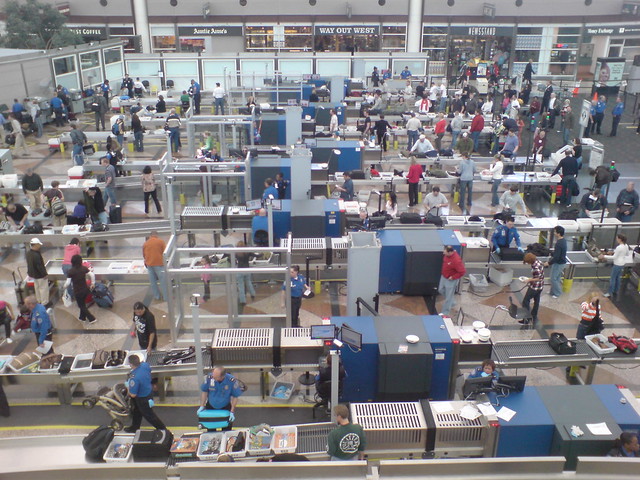
What are you looking at?  (Photo from Flickr user Six Million Dollar Dan)