Thursday, July 01, 2010

WIll In Memory Change ERP Implementations? I Think So


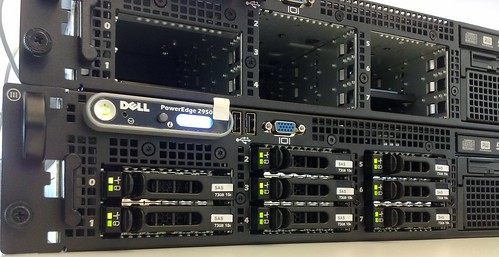
SAP is set to announce a shift in the company's approach to transaction systems this year- from systems based on relational databases to those based on holding all main transaction data in a system's Random Access Memory (RAM). SAP is calling this technology "In Memory" and it could signal a big change in the environment for enterprise IT systems.


The argument for his technology is speed. RAM is very very fast. Relational databases stored on storage networks are slow. If you hold all major transaction data in RAM, your ERP system can become incredibly fast and responsive to queries. You can easily parse and present data in near real time and respond to queries.


If companies actually shift to In Memory ERP systems, the result could be a big change in the enterprise IT landscape. For a start, most BAO systems that extract data for analysis might not be needed. Why extract data for faster analysis, if you can do almost any analysis you want in near real time? Similarly, most advanced planning and scheduling systems, including SAP APO might no longer be needed. Most APS systems are in-memory systems that extract only a subset of enterprise data needed for quick supply chain analysis.


As the price of memory declines, the possibility of this vision coming true increases. While traditional hard drives have proven resilient for consumer use, enterprises have a proven willingness to pay for performance where they can find a true ROI. The power and speed afforded by an in memory ERP would generate just such a return. Is it possible. Larry Ellison, now a hardware guy and a software guy thinks not. Certainly, for it to work, companies will have to learn to exercise some restraint over their transaction volumes- and learn to use the archiving functionality in the ERP.


If I had to place a bet, it would be here. APS systems were the first big IT systems to use a purely in memory model, and the result was a powerful new set of analytical and business tools. To make APS work, you had to carefully select the data you would pull from the ERP into memory. That was ten years ago, probably 5 cycles of Moore's law. Today, why not just use it all?


If this vision of the future comes true, then there are profound implications for leading software companies. Databases and BAO offerings might need to be rethought. There would still need to be BAO, but now, instead of working on our database, we would need to access the ERP in memory through an API, giving much more control to SAP. In services, we would need to work much more closely together between ERP implementation and BAO and supply chain planning, since all activities would draw upon the same system.


The rise of in memory could also lead to another enormous ERP implementation boom. It is likely that current ERP systems will need to be reimplemented or restructured to take advantage of this technology. This is no simple technical upgrade and it could also require huge amounts of new hardware. When i worked at i2, I installed demand planner at Compaq. In the quarter we completed the install we needed so many high end servers with maximum memory, we reduced their revenue for the quarter by taking up those servers. And that was just demand planning.


Such an enormous demand for hardware might further accelerate the transition to cloud computing, as companies look for ways to get in memory ERP benefits without spending too much up front. It's a long chain of events from the first in memory ERP to global re-implementation of ERP and a shift to the cloud. Right now, it's all speculation, but if we ignore it, we risk finding ourselves unprepared for a very different future.


The Economist Article. Photo from Creative Commons:


image


Recommend this Entry No Ratings 0

Dude, You Got A Dud: Crowd-Sourcing Your Supply Chain Strategy

Nothing invites scrutiny like secrecy.  Apple does a great job of fanning interest in their new products.  That scrutiny goes far beyond features and functions - it delves all the way into engineering designs and supply chain planning.  Thanks to bloggers, readers, and observant and interested experts, we probably know more about Apple's supply chain than any other technology company in the world.  

All that transparency is probably doing a lot of good at Apple.  Since the iPhone 4 came out, antenna issues and shattering glass have received tremendous attention.  Apple has had to be fairly clear and forthcoming about the causes of these issues.  One liners on how to hold the phone notwithstanding.

Let's contrast that with the lawsuit against Dell published in yesterday's New York times.  (Link).  Without the disclosure required by law, it may be that few people would have ever found out about the defective parts.  It seems it took Dell years to deal with the issue - something that would never have happened had all those component failures been blogged about intensely.

There a lesson here and it’s not about keeping things secret.  If you're not Apple or a scandal-plagued celebrity, there's a good chance that you won't get lots of extra scrutiny if you try hard to keep secrets.  For regular companies, increased transparency is a good thing, not a bad one.


Monday, June 21, 2010

EVO 4G Looks Great, Sprint Retailing Lags

On Friday afternoon, I met the CTO of Limelight networks for lunch in Palo Alto. Hanging out on university avenue in Palo Alto, about 15 minutes early for my meeting, I walked through the Apple store and then on to the Sprint store. At the Apple store, I did what I always do: swore I woulnd't buy anything and then bought something. In this case, a stand for my iPad. It set back $30.

I then wondered over to the Sprint store. Balloons were out front and the place was surprising crowded for Sprint store (there were like 10 people in there!). I forgot that the HTC EVO 4G launched on Friday. I went over to have a look at it. Hard to do so when there were 10 people straining to get a look and only 2 on display.

Killing a few minutes and waiting for the crowd to disperse so I could play with an EVO, I wandered over the Palm Pre display. I've never had a chance to play with the Palm (soon to be HP) pre. This was not my time either. Both Palm Pres on display in the store were dead, no battery and no power. And so the painful contrast with Apple was so very clear. At the Apple store, there are dozens of every new device on display. You never have to wait to get your hands on a device. And they all work.

I did finally get my hands on an EVO. It's huge yet slim, it has a beatiful screen, and HTC has done a terrific job making Android look slick. Every thing on it is fast and powerful. Web surfing is amazing on the huge screen and Sprint's 3G network is respectably fast. Despite this, I'll be sticking with my T-Mobile blackberry for the moment. Early data shows that T-Mobile's 3.5G network (HSPA+) is running faster than Sprint's 4G network and with a $300 early termination fee for new users, I'm not in the mood to be chained to Sprint at the moment.
Big & Beautiful, the EVO 4G. Flickr CC photo:
image


Amazing iPad Software Evolution

I suppose if I had owned an iphone for the last few years I would have seen this process in motion, but as a new iPad owner, I'm seeing first hand. I'm writing here about the amazing pace of software evolution and innovation in the Apple ecosystem. I have about 30 applications that I've downloaded and purchased for my iPad.

My favorite example of this: note-taking. The iPad uses a capacitative screen, something that's finger friendly, but not very useful for note taking. It doesn't work for note taking because one's natural inclination is rest your palm on the screen while you write. And as the screen detects all touches, that leads to lots of strange marks on each page. Historically, this problem has been solved by using an electromagnetic pen on a screen that is not touch sensitive. That's how note taking works on a Thinkpad, for example. Steve Jobs, however, is not fond of the stylus and doesn't think one is needed, so there's no provision for that on the iPad.

The Apple ecosystem quickly solved this problem, however. Companies like TenOne design developed specialized styluses that mimic the touch of a finger and software developers created a bunch of different ways to address the needs of inking. Many of these programs are already in their second or third generation, even though the iPad itself is only a two months old.

I think I've purchased about every one of hand-writing note taking programs out there, and so far, I've got three favorites, but no absolute winner yet.

FastFinga: a brilliant piece of software from down under, these guys wrote a version for the iPad without even having an iPad to test it out on. The program is designed for fingers - hence the name, but it works very well with the stylus. You write at the bottom of the screen, in large type, and it condenses your output. It outputs to printers, jpeg, and Evernote. Output looks smooth and polished.

image

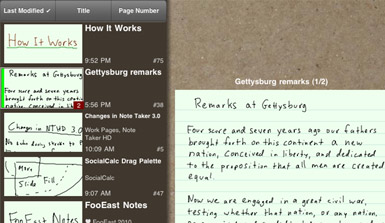
NoteTaker HD: this program operates in a similar way to FastFinga, but is more tuned up for full pages of notes. Writing in the first edition looked bad, but it has since improved. NoteTaker lets you export in a variety of modes and also condenses your writing nicely, since it's not easy to write in small letters on the iPad screen.


image
Penultimate: this is overall favorite so far, and the only one of the three that didn't get it's start on the iPhone. Penultimate is a "one man" operation in San Francisco, but so far has the most ingenious solution to hand palm-on-pad issue. Penultimate simply ignores touches that don't look like a stylus writing. If you're right handed, it works brilliantly and the text looks smooth and polished. The only downside of penultimate is that it can't shrink big chunks of text down, so a hour our meeting can quickly stretch over 10-15 pages of notes.

image

Perhaps the most amazing thing about all three of these programs is that not one of them costs more than $5. The enormous size of the Apple market and the willingness of customers to drop $2-5 on a good program means that even at low prices, volumes are high enough to give very generous rewards to good developers. And competition is intense, too, so updates come quickly and developers respond quickly to user feedback, lest they negative feedback in their user ratings.

The Essential iPad Applications & Accessories List

After two months of having an iPad, I’ve taken stock of the apps on my iPad that I actually use.  I’ve got a lot more that don’t see much use, but these are the ones that I find myself using day in and day out.  This doesn’t include the Apple-installed basics - just the extras I’ve purchased or obtained for free from App Store.

1. Productivity
  • Evernote: I’m a desktop PC evernote user for some of my notes.
  • FastFinga: A great note-taking application, with geotagging and export to Evernote.
  • Numbers (Excel): this does a very nice job of opening excel sheets and an even better one of creating new sheets in Apple’s proprietary format.
  • Pages (Word): another great Apple application, but only if you have a Mac.   Doesn’t natively export and import Word files.
  • Keynote (Powerpoint): as with the other Apple office suite apps, they’re terrific - by far the most polished on the iPad, but limited to Apple’s proprietary format for exporting.
  • Documents To Go: when you need Microsoft Office compatibility, this is the one.
  • Penultimate: A terrific note taking application, the only one that prevents accidental touches to the screen while you rest you hand on the device.
  • NoteTake HD: Another elegant note taking solution. 
  • Adobe Ideas: A great and free sketchbook for doodles and charts.
  • iAnnotate PDF: There are lots of PDF readers, but this is the one allows you to annotate documents, sign them, and email them back out.  A great substitute for a fax machine.
  • DropBox: I save personal files online with DropBox and this makes them available on the iPad.  It also provides for local storage of “favorite” documents.
  • DragonDictation: Honestly, I don’t use this one much.  I can’t quite get used to dictation, but I keep hoping I can try it one day and make it work for me.  Word recognition is great, but I can’t speak in a way that reflects my writing.  Yet.

2. News & Media
  • Instapaper Pro: Stores your web reading for later in a nicely formatted way.
  • Kindle: My main bookstore now and as a good as Apple’s iBooks reader.
  • Google Earth: More fun than the maps application.
3. Music & Video
  • Pandora (US Only): the best music discovery service.
  • ABC Player (US Only): online TV from ABC.
  • Netflix (US Only): watch-now.  Netflix does a great job of showing how online movie watching should be, but selection of content still sucks.
  • MusicOne: my favorite web radio station, now with it’s own app.
  • Shazam: recognize the music you’re listening to.  Works in clubs where they pump up the volume, but you’re out of luck if you want it to recognize the Lawrence Welk tune they’re pumping into the elevator at low volume.
4. Accessories
  • Pogo Stylus: essential for writing on the iPad.  I don’t care what Steve Jobs says, we don’t learn to write at school using our fingers.  We use pens.
  • Apple iPad Case: durable, safe, and just right for typing or watching movies.  The best case I’ve seen so far.

Tuesday, February 20, 2007

Indian Airlines: Indigo's Sustainable Model

Facing a 3 hour delay on Kingfisher, I negotiated a transfer to Indigo airlines on my last domestic flight in India. I was impressed with the start-up discount carrier and I believe that have the most sustainable long-term model for India's growing domestic market.

Indigo most closely resembles Southworst or RyanAir - a no-frills, all-economy-class airline flying a single jet type (A320) on short-haul routes. Indigo has no fancy in flight entertainment, no fancy amenities, and just like RyanAir, sells products and snacks other than water on board. For a 90 minute flight, this is just fine and I didn't see any passengers complaining.

The no-frills structure allows them to turn aircraft faster than competitors and while I have no data to prove it, I'm guessing that they enjoy a superior on time performance as a result. Additionally, as wage costs and congestion affect the Indian skies, Indigo's quick turn, low-cost model may be much more scalable than the high touch services offered by competitors.

In my experience, Indian consumers are very modern in their approach to purchasing products - they adhere to the "Well Curve" philosophy rather than the "Bell Curve". That means that for some services they prefer low cost, low touch and for others high cost and high touch. While domestic services for Jet Airways and Kingfisher sit in the middle of this picture, Indigo sits neatly at one end of the scale. I believe it will be a hit with cost conscious Indian travelers.

Sunday, February 11, 2007

Indian Airlines: Kingfisher- When JetBlue meets Virgin

Kingfisher is a one a host of new Indian Airlines that have taken to the skies in the last few years. Kingfisher operates a fleet of Airbus A320 and A321 jets on domestic routes across India.


The Airbus A320 I flew on from Bangalore to Pune offered a single class of service, though the effort was made to make it "high class." Every seat was equipped with a personal video system very similar to that offered by JetBlue. I believe it was a live satellite feed, but I was unable to confirm that. The seat-backs offered 8 channels plus an in-flight GPS status page. I didn't see anyone watching the tedious collection of Bollywood musicals, but I assume it's popular with some passengers.


The flight from Bangalore to Pune is just about 90 minutes. In that short flight time, the Kingfisher staff provided amenity kits to every passenger that included complimentary headphones as well as a hot breakfast. The service was competent if not very friendly. I sat in an exit row and was made to move my small briefcase to the overhead bin even though it fit underneath the seat in front of me. In the exit row, leg room was barely acceptable and in regular rows it looked down right painfully tight in there.


Kingfisher gives every appearance of having an unsustainable cost structure, similar to Jet Airways. Catering short flights is probably not necessary and the impact on turn-around time is probably very serious. I didn't see published on-time performance ratings for Indian airlines, but I suspect they are poor and tend to get worse as flights collect delays during the course of the day. My return flight was over 3 hours late.


Wednesday, February 07, 2007

Better Than The Hotels: India's Growing Airlines

Freshly back from a trip to Banaglore, I posted my opinions on India's hotels. I have also now sampled a full array of the local airlines and am posting my results here.


Jet Airways: High Class, High Cost, An Unsustainable Model?

Jet Airways is the success story of India's new aviation sector, doing a land-office business domestically and expanding into the vacuum created by Air India's horrendous service and decrepit planes overseas. They fly modern Boeing jets domestically and Airbus wide-bodies overseas.

The service is "high touch" and modeled on Singapore Airlines. Meals on even short domestic flights including hot towels and a first class section. The airline has a frequent flyer program and offers services such as online check-in. Expatriates will be most comfortable flying Jet Airways and I would predict that they will be the first to join one of the global alliances, probably Star.

The downside of Jet Airways: their operating model may be too complex to be sustainable. Flight times within India are probably not long enough to sustain a hub and spoke model and catering an aircraft can really slow down a quick-turn. Additionally, as the market matures, they may find that there is limited demand for first class seats on flights under 3 hours.

Next Post: Kingfisher Airlines

Tuesday, February 06, 2007

Bangalore: If everything worked as well as your IT help desk

It may be impossible to argue with the success of India's outsourcing companies, but when it comes to hotels, Bangalore is the pits. One of my friends relayed a great story which captures the awful reality of the city's hotels. He was on the phone to a colleague and she asked where he was - he said he was at the Sheraton in Bangalore. "Oh," she said, "I can smell it now."


Worst: The ITC Sheraton Bangalore


Faux British Empire style, horrible service, and a small that no amount of detergent can wash away, the ITC Sheraton Bangalore is one of the worst hotels in the city. The restaurant is mediocre, the health club is microscopic, and the pool is not exactly suitable for lap swimming.


Not Quite As Bad: The Park


Modern "boutique" style is an improvement of "glory of colonialism" at the Sheraton, but the service is even worse. Getting an airport pick-up or room service is a major event. The saving grace of this hotel is the 25 meter pool. Though designed more as a location around which fashionable people can hang-out and been seen, it does quite well for lap swimming. On my stays, I was the only person actually seen in the pool.


Almost Passable: The Meridien Bangalore


I have not spent the night at this hotel, but the meals and business events I have been to at the Meridien have all been passable if not exactly wonderful. The hotel seems well maintained and I think I'll be trying it on my next trip to India.

Monday, January 29, 2007

Lufthansa to Passengers: Sorry About The Windows

I just arrived in India for four day visit. I came over on Lufthansa from San Francisco to Frankfurt and then on to Bangalore. On the San Francisco to Bangalore flight, Lufthansa finally showed their new business class along with their new AVOD in flight entertainment system.


As IFE systems go, the selection of music and video was good. Unfortunately, the system was slow as molasses and clumsy to use. Movies occasionally ground to a halt and music sometimes wavered or cut out. At one point, an announcement was made to the entire plane apologizing for the technical issues with the system. Towards the end of the flight, the cabin crew had to reboot the IFE system. At that point, we got to see some interesting details:


- System software: Microsoft Windows CE
- System Integrator: Rockwell Collins


Lufthansa also fixed their in-seat power plug adapters. The old ones, though ostensibly a regular plug, never worked very well. The new ones have a tight fit and seem to work well without an adapter. There was an Ethernet plug and USB plug in my seat as well, but I didn't get around to trying them out.

Thursday, September 21, 2006

Early Mornings, Late Nights, Those are the Best Flights

I definitely prefer early morning and late night flights, all the better for getting your work done at the client before heading home. They also seem consistently more reliable than middle-of-the-day flights that get bogged down in air traffic delays. Since I commute mostly from San Francisco to New York, this basically means the red-eye there and the last flight back. At the airport yesterday, I noticed that United is adding one new flight between San Francisco and New York every day, an early morning departure from SFO to JFK and one late night return from JFK to SFO.

The new morning fligth leaves SFO at 6:05am and gets in to new York at 3:30pm and the return departs JFK at 8:40pm, arriving back into SFO at midnight.
The morning flight should be nice to get into New York at a reasonable time, although it's pretty much means your day is shot froma work & meeting standpoint. Going East with the time difference, there's nothing that will fix that. The return flight, however, is very appealing.

The 8:40pm departure from New York is a huge improvement on the past when both AA and United's last flight from New York back to San Francisco departed at around 6pm. This was a ridiculously early departure that required you to leave Manhattan at no later than 3:30 to make the plane. It also departed at the peak hour from JFK for all flights, resulting in huge waits to take off. Last week, after we pushed back from the gate at 6:45 (late), we inched our way to the runway where the captain announced we were number 75 for take-off. An 8:40pm departure should be smooth(er) sailing by comparison.

Wednesday, September 20, 2006

Stealth Price Increase At The Rental Car Lot

In this day and age of high competitive intensity and prudent corporate purchasing, it's hard for travel suppliers to push through price increases, but here's one that Hertz and Avis are getting through: increased charges for gas.

I don't mean the charge for refilling the tank, already outrageous, I mean the charge for using a gas guzzling SUV they gave you as a free "upgrade" the last time you rented a car. As a frequent renter at Hertz, I often my car has been "upgraded" to a gas guzzling land yacht or SUV, sticking me with tab for extra gas on a car I didn't want and can't park anywhere.

While you can always go back to the Hertz gold lot and try to exchange the car, that's valuable time you're wasting. They are, no doubt, counting on that.

Tuesday, September 19, 2006

Economist Skewers Lying Airlines


About a three months ago, I got reprimanded loudly by a not-very-clever air marshall. As the plane descended towards the runway, I switched on my Blackberry in violation of the airline rules. The air marshall, who happened to be sitting next to me, told me that use of use of WiFi is not permitted on board. Telling the air-marshall that the device was not WiFi did not improve my standing. How much I enjoyed to read in last week's edition of the Economist a sarcastic editorial containing a much more truthful variation of inflight announcements. Since the Economist has deemed this article as one of the ones they don't share for free on the public web-site, I'll just share a few selected quotes and you'll have to visit their site to read the rest. My favorite:

"Please switch off all mobile phones, since they can interfere with the aircraft's navigation systems. At least, that's what you've always been told. The real reason to switch them off is because they interfere with mobile networks on the ground, but somehow that doesn't sound quite so good. On most flights a few mobile phones are left on by mistake, so if they were really dangerous we would not allow them on board at all, if you think about it. We will have to come clean about this next year, when we introduce in-flight calling across the Veritas fleet. At that point the prospect of taking a cut of the sky-high calling charges will miraculously cause our safety concerns about mobile phones to evaporate."

Another good one:

Once we have reached cruising altitude you will be offered a light meal and a choice of beverages—a word that sounds so much better than just saying ‘drinks’, don't you think? The purpose of these refreshments is partly to keep you in your seats where you cannot do yourselves or anyone else any harm. Please consume alcohol in moderate quantities so that you become mildly sedated but not rowdy. That said, we can always turn the cabin air-quality down a notch or two to help ensure that you are sufficiently drowsy.

The Economist has just reminded me again why it is the best newspaper in the world.

Monday, September 18, 2006

Strange Rituals

I went to the doctor this morning for my annual check-up. In fact, today, I had everything fixed. I started with the most important stuff, my car. I had it dropped off for service this morning at 7:30am. I then proceeded on to the dermatologist and then to my GP (General Practictioner).


Both my dermatologist and my GP like to poke and prod and see lots of skin, if only to determine that I still don't have skin cancer. The thing I find odd is that they both leave the room for you to undress and then come back in. Then, after they've seen stuff that I don't get around to viewing, the leave the room so you can dress again. This is a utterly perplexing ritual I mean, just stay while I get dressed. You're not going to see anything new.

Friday, September 15, 2006

Seriously: How much does it really cost to go to New Jersey?

Every time I get in a cab and go to New Jersey, I get a completely different fare. In the last month, I've been told:
  • It's a flat fare
  • It's meter and half
  • It's meter plus $23
  • It's meter plus $15 and tolls to/from the destination
On Friday morning at 5am, on my way to catch a flight, I finally got fed up. Not only did the cab driver charge me meter plus $23 but he took the slowest route I've ever seen and kept strictly to the speed limit. It's not until someone actually drives the speed limit that you realize how freaking slow it is, especially at 5am. So, how much does it cost to go to New Jersey? 1. To Newark Airport: Meter + $15 + round trip tools 2. All other destinations: subject to negotiation

Where did I learn such incredible wisdom? The New York Taxi & Limousine Commission website.

Thursday, September 14, 2006

Concorde - RIP 2003


Too rich for my finances, but I could always enjoy the idea that the Concorde would be around for me to fly on it. Wikipedia has a wonderful article on the history of this great plane. One day, we're told, there'll faster planes. In the meantime, we'll be cruising below the speed of sound.

One amusing thing I found out about this plane is that in the US, briefly, it served domestic routes between Dallas and Washington for Braniff, though it was not permitted to operate above Mach 1 in the US

Wednesday, September 13, 2006

Metricom Wireless - RIP 2001

Before 3G, before EVDO, there was Metricom, a metropolitan wireless service that covered the SF bay area using unlicensed spectrum for just $30/month.
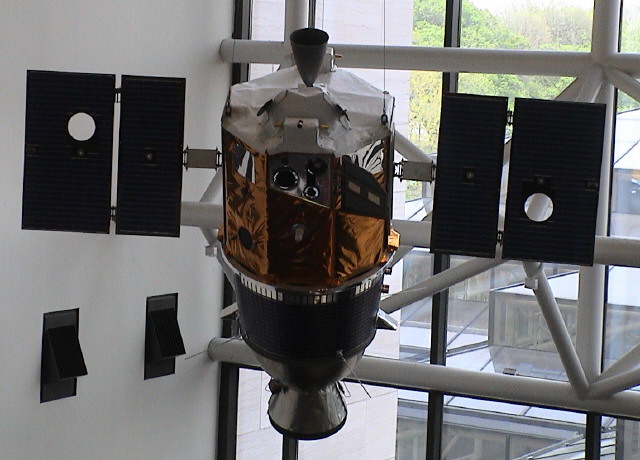
Metricom had two lives, first as SF metro service in the late 1990s and then again as a multi-city service in 2001. The original company that provided the service, Metricom, went bankrupt and has since been resurrected to offer the service in Denver and San Deigo.

Tuesday, September 12, 2006

Connexion By Boeing - RIP 2006

Another wonderful service, Boeing's high performance satellite based internet service will be disconnected later this fall. For the entire flight, $35 was a great deal. You could get a full day of work done at speeds that rivalled DSL.

I've used the service on Lufthansa several times and it turned a long flight into a very productive flight. Apparently, however, there are not many people who feel the same way because Boeing was unable to sell the service or make any money on it after investing over $1 billion.


Monday, September 11, 2006

What happens when you don't cross the chasm - you fall in it

Most of the time, great technological products "cross the chasm" - they gradually go from niche solutions to blockbuster mass products. Sometimes, instead of crossing the chasm, however, they fall into the chasm and great technologies disappear.

Earlier this week, I boarded a flight and found out that the Verizon Airfone, my dependable ally that helps me be in 2 places at once, disappeared. The phones on board the United aircraft where all shut-off. Although Verizon's license continues until 2010, they decided to shut-off the service early after losing the bid for the next generation on board services. So, we'll all have to wait probably another 3-4 years while airlines promise to provide us the next generation of on-board cell-phone and data service.

In honor of the death of Verizon's airfone serivce, I've collected a few other technologies that fell into the chasm instead crossing it and I'll post them this week.

1. Verizon Air Fone


The original airfone providing domestic service for just $0.10 per minute for Verizon Wireless customers. In it's earlier incarnation as the GTE Airfone, they used to offer a deal - $15 per call, unlimited time. For me, that meant 9.6kb dial-up from New York to LA on one call.

Saturday, September 09, 2006

No such thing as sleep deficit?

There's more and more research that suggest that sleep deprivation is real and that people who accumulate sleep deficits need time to recover from a lack of sleep. This explains how I spent labor day weekend.
For now, the only known cure for sleep deficits are getting extra sleep, something that's hard to do as most people short on sleep are not staying up late watching movies. I liked this
article on sleep very much, although it was hard to stay awake to finish it.

Friday, September 08, 2006

Lots of Life Left in the PC Biz

This last weekend, my home desktop PC started making all kinds of obscene noises. Suddenly, my hard drive sounds like a piece of heavy machinery with a bolt loose. Despite this incredible racket, the system continues to chug along performing it's mission critical tasks: recording TV shows and saving them for me.

Nonetheless, I have seized upon the opportunity to buy a new PC and have started searching for possible options. It's very easy to run out of "name brand" players in about 5 minutes. Lenovo does not offer a media center PC. HP and Dell both offer Media Center PCs, as well as Alienware (part of Dell) and Gateway.

I kept looking, and, to my surprise, found at least a dozen other PC makers offering up customized Media Center PCs. All these other PC companies seem to be focused on the high end, with prices started at $900 and rising well above $3,000 for decked-out gaming systems with multi-core processors.

Clearly, someone is making money in the PC business, and all this little niche players are showing the way forward. They invariably offer high end performance, sleek product cases and form factors that are closer to a bulky VCR than a desktop PC. They are earning premium pricing (and presumably margins) from all this customization.

Thursday, September 07, 2006

Miracle on Wall Street

Last week on Sunday night at 1am, I left my Blackberry in a cab at the corner of Wall Street and William street in lower manhattan. On Monday night, my Blackberry had been returned to the hotel front desk. Wow!

Wednesday, September 06, 2006

California Wine Country

I spent the long labor day weekend sleeping and eating up in Mendocino county. No, this is neither the famous Napa valley nor the newly famous wine country of Santa Barbara (thank you Sideways).

Mendocino country, and specifically, the Anderson Valley, is a great part of the less well known but not entirely undiscovered wine country of Northern California. The Anderson valley is known for it's great pinot noir grapes that make wonderful wines and sparkling wine (shhh...don't say Champagne).

My favorite places in the Anderson valley include the Boonville Hotel which serves amazing meals, the Goldeneye Winery, and the Scharffenberger and Roederer estates.

Tuesday, September 05, 2006

Battle of the High Tech T-Shirts

It's summer time and that means that one short trip in the New York city subway will leave you dripping with sweat and sticky just in time for your important meeting. In search of something better, the ultimate t-shirt that keeps you cool in the summer and warm in the winter, that wicks sweat and never smells, I tested some of the different high tech t-shirts. Here are the results:

1. The Best

SmartWool: A wool T-shirt for $50? Am I crazy. I must be because they actually do what they said and they never smell bad after a long day. I also used one as my running T-shirt on a business trip, wearing it on each run without washing inbetween. After a week, it still had no smell whatsoever.

2. Pretty Good

Columbia Titanium: These shirts are very comfortable and although they are polyester, they do have anti-bacterial and odor fighting properties that keep them fairly fresh. The only t-shirt I could find in an entirely neutral white.

Arc'teryx: Another excellent running shirt, unfortunately none of the colors were suitable for wearing under a collared business shirt.

Patagonia: Great shirts, they do eventually get that polyester odor, but not quickly. Very comfortable and very good at keeping you from becoming too sweaty during the day. An odor-free version is promised for this fall.

3. Not acceptable

North Face: Very comfortable shirts, great breathability, but they reek after just one use. You can smell one of these shirts across room, unfortunately.